Beginning with the Linux 6.19 kernel, the hung task detector and system lock-up detector are now optionally able to provide greater insight into the issues by dumping additional system information. The new lockup_sys_info and hung_task_sys_info sysctl knobs were merged over as part of the pull requests managed by Andrew Morton...
December 08, 2025
Phoronix
Live Update Orchestrator "LUO" Merged For Linux 6.19
Google engineers for the past number of months have been working on the Live Update Orchestrator as a new way of applying live Linux kernel updates. The Live Update Orchestrator "LUO" builds atop the Kexec Handover "KHO" functionality already within the kernel. Google has since been deplyoing LUO in their production environments for faster security updates to kernels, especially when involving VMs. LUO is now upstream in Linux 6.19...
Meson 1.10 Build System Adds OS/2 Support, Experimental C++ "import std"
Meson 1.10 is out today as the newest feature release for this popular cross-platform build system...
Firefox 146 Now Available With Native Fractional Scaling On Wayland
The Mozilla Firefox 146.0 release binaries are now available with a very exciting improvement for Linux users relying on Wayland...
Intel Arc B580 vs. AMD Radeon RX 9000 vs. NVIDIA RTX 50 Series For Llama.cpp Vulkan Performance
Recently there were Phoronix benchmarks looking at the Intel Battlemage GPU compute performance since last year when the Arc B580 graphics card launched as well as the OpenGL and Vulkan graphics performance for the B580 on Linux since launch. There was much progress on the open-source Intel Linux graphics drivers at large this year but especially for Battlemage. Following that a Phoronix Premium reader asked about seeing some fresh Llama.cpp AI benchmarks with its Vulkan back-end now for the Arc B580 compared to competing AMD and NVIDIA graphics cards. Here are those benchmarks as requested.
Early Benchmarks Of Linux 6.19 Git Raising Some Concerns
While just half-way through the Linux 6.19 merge window, over the weekend I began running some benchmarks of the current Linux 6.19 Git state compared to Linux 6.18 LTS stable. There are some minor performance improvements to note in a few of the tests on the first system I tested but also some regressions at this very early pre-RC1 state of the Linux 6.19 kernel...
AMD Working On Push-Based Load Balancing For Linux To Further Enhance Performance
One of the new Linux engineering initiatives out of AMD is working to further enhance Linux performance on today's large core count systems by introducing push-based load balancing...
Several Logitech Devices Seeing New/Improved Support With Linux 6.19
All of the Human Interface Devices (HID) subsystem updates were merged a few days ago for the ongoing Linux 6.19 kernel merge window. Standing out this cycle on the HID side are seeing new/improved support for several Logitech devices...
Linux I3C Gains "HDR" Support For Faster Data Transfers
I2C in Linux 6.19 brought support for Rust-written I2C drivers. The newer I3C "Improved Inter-Integrated Circuit" interface changes have now been merged and the big feature there is HDR support. Not to be confused with the more common High Dynamic Range acronym usage for HDR, HDR in the I3C context is for the "High Data Rate" mode for facilitating faster data transfers...
Arm MPAM Driver Upstreamed To The Linux 6.19 Kernel
The ARM64 code changes were merged last week into the in-development Linux 6.19 kernel. The most notable of the ARM64 architecture changes this cycle is landing the Arm MPAM driver for Arm's Memory System Resource Partitioning and Monitoring...
The Daily WTF
CodeSOD: The Magic Array
Betsy writes:
I found this snippet recently in a 20-year-old RPG program.
Ah, yes, twenty years ago, RPG, that means this was written in the 1970s. What? No. That can't be right? That's how long ago?
Joking about my mortality aside, in the early oughts, most of the work around RPG was in keeping old mainframe systems from falling over. That entirely new code was being written, that new projects were being started twenty years ago is not a surprise, but it's unusual enough to be remarkable. That said, the last release of RPG was in 2020, so it clearly keeps on keeping on.
In any case, this developer, we'll call them "Stephen", needed to create an array containing the numbers 12 through 16.
Let's take a peek at the code.
     D RowFld          S              3  0 DIM(5)
     D X               S              3  0
     D Y               S              3  0

     C                   EVAL      X = 12
     C                   FOR       Y = 1 TO %Elem(RowFld)
     C                   EVAL      RowFld(y) = X
     C                   EVAL      X = X + 1
     C                   ENDFOR
The first three lines create some variables: RowFld, which is an array containing 5 elements, and will hold our offsets. X and Y are going to hold our numeric values.
We set X equal to 12, then we start a for loop from 1 to the length of our RowFld. We set the element at that index equal to X, then increment X.
The code is awkward, but is not exactly the WTF here. This particular program displays a file and a subfile, and these values are used to position the cursor inside that subfile. The array is never iterated over, the array is never modified, the array would 100% be better managed as a set of constants, if you didn't want to have magic numbers littering your code. More than that, the location of the subfile on the screen has never changed. And let's be fair, this didn't get rid of magic numbers, it just made them one through five, instead of 12 through 16, as the indexes in the array are just as arbitrary.
In other words, there's no point to this. Even if the specific version of RPG didn't have constants variables that you handle like constants would be fine (my checks on the documentation seem to imply that CONST first appeared in version RPG IV 7.2, which makes it look like circa 2016).
But there's one more bit of weirdness here. Stephen had several years of experience with RPG, and all of that experience was from the "free-format" era of RPG. You see, way back in 2001, RPG finally freed itself from its dependency on punchcards, and started allowing you to write code as just strings of text, without requiring certain things to exist in certain columns. This was a generally positive enhancement, and Betsy's team immediately adopted it, as did everyone running the latest versions of RPG. All new development was done using the "free-format" style, so they could write code like normal people. They even had a conversion tool which would do some simple string manipulation to convert legacy RPG programs into the modern style, and had basically abandoned the legacy style without looking back.
Except for Stephen, who insisted on the column oriented format. Who protested when anyone tried to modify their code to modernize it at all. "Oh, we used free-format at my last job," Stephen said when pressed, "but it's confusing and columns are just cleaner and more readable."
Eventually, someone else wrote a program that absorbed all the functionality in Stephen's program. Stephen kept plugging away at it for a few years afterwards, because a handful of users also refused to migrate to the new tool. But eventually they left the company for one reason or another, and Stephen found himself without users for his work, and left with them.
 [Advertisement]
ProGet’s got you covered with security and access controls on your NuGet feeds. Learn more.
[Advertisement]
ProGet’s got you covered with security and access controls on your NuGet feeds. Learn more.
Phoronix
Iced 0.14 Released For Popular Rust Cross-Platform GUI Library
Released today is a new version of Iced, the popular cross-platform GUI library for the Rust programming language. Iced is notably used by the COSMIC desktop environment and a growing variety of different Rust apps...
 C++11 gave us


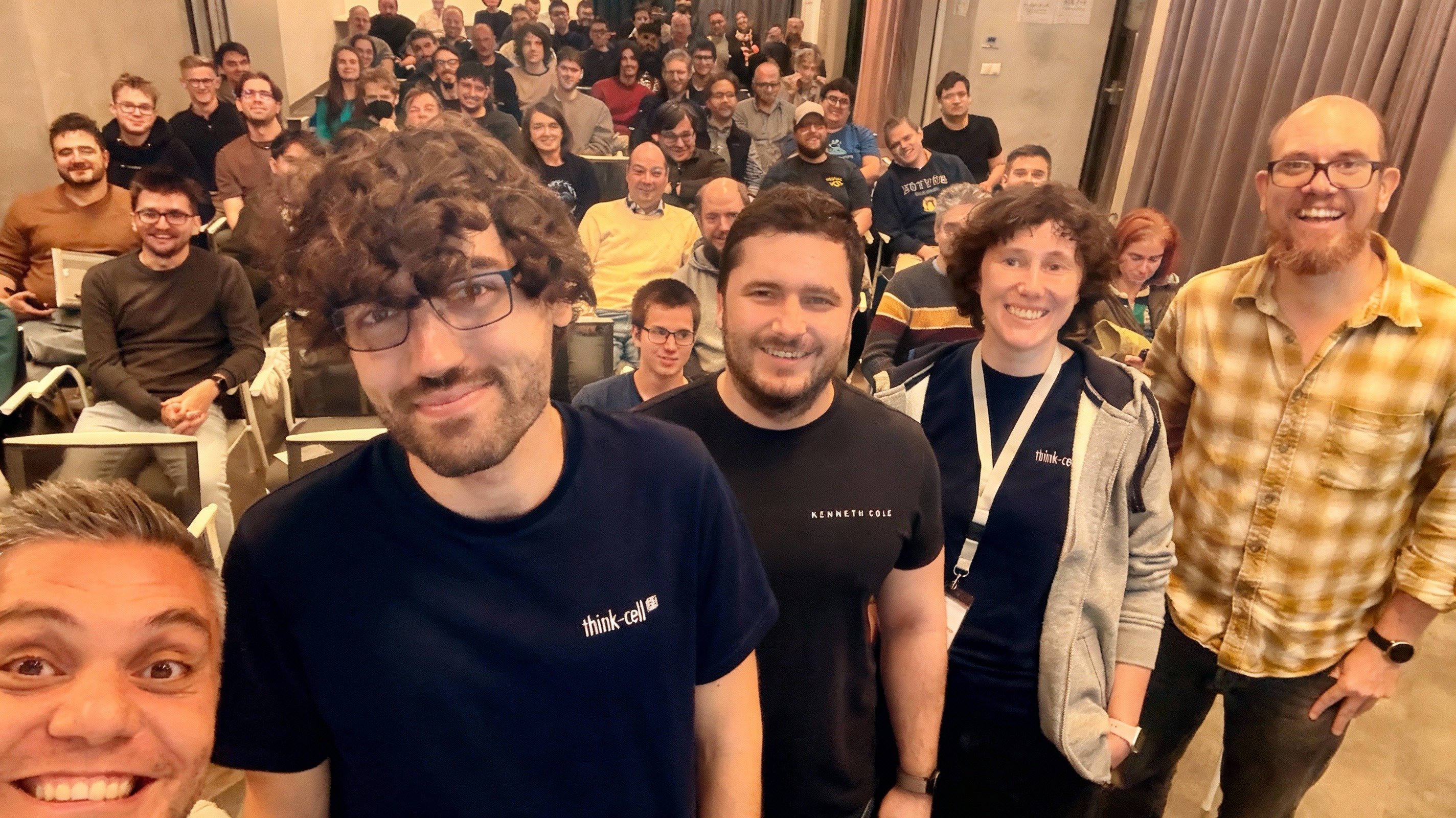 The Budapest C++ Meetup was a great reminder of how strong and curious our local community is. Each talk approached the language from a different angle — Jonathan Müller from the perspective of performance, mine from design and type safety, and Marcell Juhász from security — yet all shared the same core message: understand what C++ gives you and use it wisely.